
R&D Log: The Demo Campaign — Hunting the Perfect Closed-Course Weapon

When you realize your current cruiser platform has reached its hard mechanical limits, you don't just guess at the replacement, you collect data. To figure out exactly how a performance chassis should handle under load, I launched a relentless campaign, hitting every manufacturer demo event I could track down. From regional cruiser meetups to testing adventure bikes in the high desert dirt, and finally throwing legs over premium European scalpels, here is the raw telemetry from the field.
1. The Cruiser Baseline: Indian Motorcycle Demo
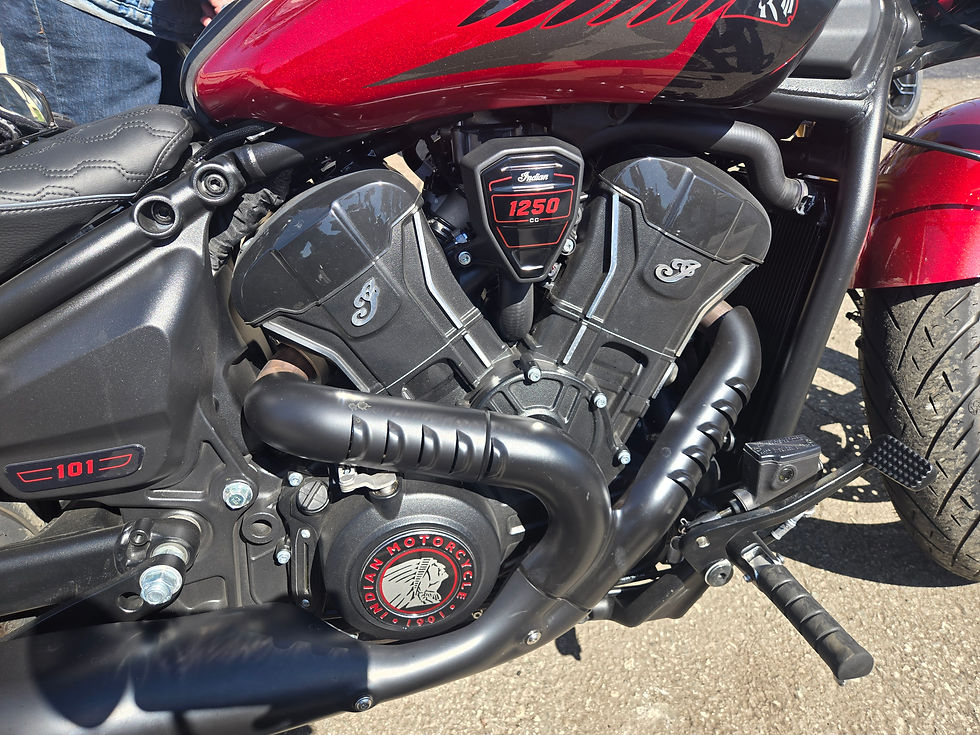
My testing began at an Indian event, where I gridded up on the Scout Street RT and the Scout Sport 101. The build quality and mechanical refinement of these machines are undeniably incredible. They are beautiful bikes, but they are bound to the cruiser form. The long, forward controls were incredibly uncomfortable for my lower body, reinforcing exactly why I need to transition away from this layout for high-speed tracking.

However, the powertrain on the Sport 101 deserves serious respect. Of all the bikes I have tested across this entire campaign, nothing matches the pure, violent acceleration pull of that Scout 101 engine. If you do not actively hang onto the bars, that machine will leave you behind on the asphalt.
2. The Adventure Outlier: Harley Pan America (Biltwell 100)
To throw a completely different geometry into the data set, I even swung a leg over the Harley-Davidson Pan America at the Biltwell 100 out in Ridgecrest. Testing an adventure-chassis layout in a rugged, high-desert environment provided a massive contrast in suspension travel and upright ergonomics, expanding the baseline of how different frames respond to environmental feedback.
3. The Commuter vs. The Algorithm: Honda Demo Event
Next up was the Honda fleet, where I tested the Hornet 750 and the NT1100 DCT.
The Hornet 750: The suspension was exceptionally smooth, but it crossed the line into being overly soft. The front-end dove hard at the slightest hint of brake pressure, proving it was engineered for casual commuter comfort rather than high-performance track entry. That said, compared to my daily-driver Rebel, it definitely possessed some respectable get-up-and-go.

The NT1100 DCT: This machine left me with a massive knot of conflicting emotions. Dual-Clutch Transmission (DCT) technology is fascinating in theory, but in a demo event environment, the execution was subpar at best. Because Honda’s adaptive electronics are programmed to "learn" and adapt to a driver's specific habits, putting a brand-new rider in the saddle every 30 minutes completely breaks the software logic.
"The automatic mode was clunky, slow, and completely unresponsive. Merging onto the freeway, I twisted the throttle open to ask for power, counted to two full seconds waiting for the electronics to acknowledge the input, and then the bike suddenly downshifted and launched like a rocket ship. The lag was genuinely dangerous; the sudden burst of speed was so staggering that I almost rear-ended the vehicle ahead of me before I could chop the throttle and grab the brakes. It's an unacceptable delay that I can only hope is a symptom of abused demo electronics."
4. The Main Event: Southern California Motorcycles Demo Day
The ultimate showdown took place at Southern California Motorcycles, pitting the Ducati Monster V2 SP directly against the Triumph Street Triple 765 RS on the exact same stretch of tarmac.
The Ducati Monster V2 SP: Precision Engineering
The Ducati controlled like an absolute dream. It delivered the same incredibly smooth suspension feel as the Honda Hornet, but with the high-end firmness required for performance riding; plush when cruising, but completely taut when pushed.
The ride took an unexpected turn when a car cut into the staging lane on the freeway onramp, completely separating me and the demo lead from the rest of the pack. With an open lane ahead, I dropped the hammer. Rolling on 80% to 90% throttle, the bike lunged from 10 mph to 110 mph in roughly 3-4 seconds flat, before hauling itself back down to legal speeds with absolute composure. It was amazing. The chassis stayed completely planted, refusing to lift the front tire. As a massive fan of Ducati's engineering, especially the mechanics of the new V2 engine design and the physics-defying reverse-rotating crankshaft, the bike performed exactly like the premium weapon it is.

The Triumph Street Triple 765 RS: The Visceral Monster
Then came the Triumph. Hitting that exact same freeway onramp on the 765 RS shattered the composure of the Ducati. The moment I rolled onto the throttle with the same aggression, the Moto2-derived front end didn't stay planted, it came right up into the air.
Where the Ducati was calculated and orderly, the Triumph was a raw, visceral, unhinged experience. It delivered an intoxicating mechanical howl and an aggressive front-end lightness that completely rewrote my expectations. It is an experience I absolutely cannot shake, and I find myself deeply drawn to it.

The Ultimate Dilemma
The campaign has laid out a fascinating technical paradox. My analytical side is a total Ducati fanboy, deeply appreciating the planted, balanced stability of the reverse-rotating crank and the flawless premium suspension tracking. But my gut is still reeling from the raw, rowdy, wheel-lifting adrenaline of the Triumph Triple.
One thing is officially settled: the cruiser chapter is closing. The data has been logged, and the next step is choosing which of these scalpels cuts its way into the garage.
UPDATE LOG: June 19th R&D Follow-Up
The Campaign Continues: The telemetry gathering isn't finished yet. Southern California Motorcycles just confirmed that another Triumph factory-demo truck is rolling onto their grid on the 19th. We are heading right back down to log fresh data on two completely unique triple-powered configurations:
Triumph Street Triple 765 RX: The newly deployed, ultra-focused track weapon. Moving away from the standard upright RS layout, the RX swaps in aggressive low clip-on handlebars and a billet-machined top yoke. Combined with fully adjustable Öhlins NIX30 forks and an STX40 rear shock, it shifts rider weight completely forward to mimic a true lightweight supersport. I need to see if this dedicated, front-loaded geometry manages lower-body tension while retaining that untamed, front-wheel-lifting acceleration. Also, its just cool, I want to ride it.
Triumph Daytona 660: A fully faired sport platform utilizing a punchy 660cc inline triple. While it doesn't chase the raw, triple-digit horsepower figures of the 765, it is engineered for accessible, linear mid-range torque and agile sport handling. It will serve as an excellent baseline comparison for how a modern, road-focused middleweight chassis responds under load. This will be my first time on a full sport configuration, I look forward to comparing the ergonomics to the more upright naked's I have tested.
Expect a complete breakdown of the telemetry and ergonomics the second we get back from the tarmac. Stay tuned.


Comments